Antique & collectible identifier · iPhone
What it sold for, and where that came from.
Every other app in this category shows you a confident dollar figure with nothing behind it. Patine shows you the auction lots — the house, the month, the price, and a link so you can go and check.
Get Patine on the App Store See what a result looks like
3 complete free scans. Nothing blurred, nothing held back.
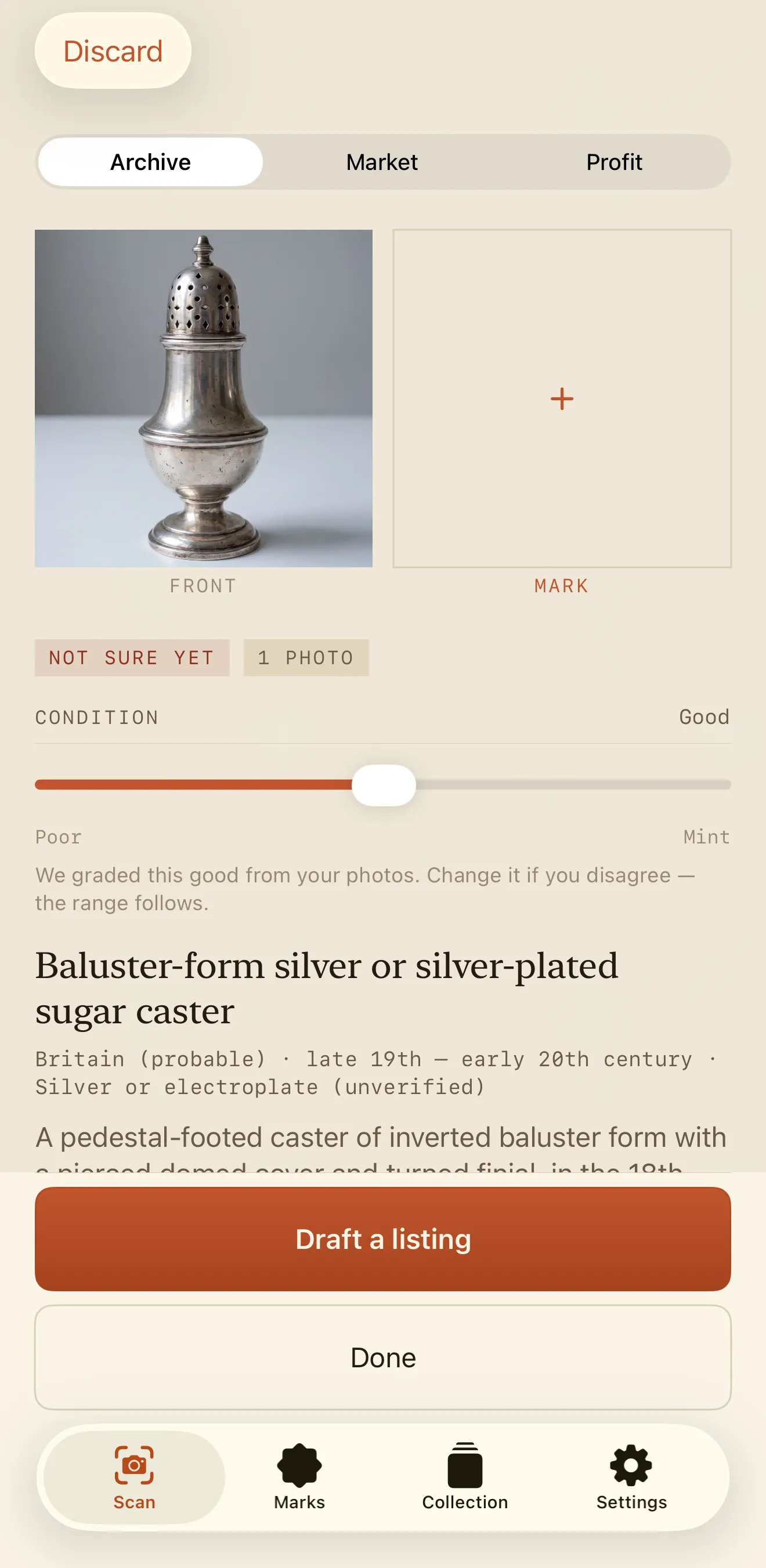
Never show a number without showing where it came from. When we don't know, say so, and say what would make us know.
A real result
01
Victorian silver four-piece tea service
$1,200 – $3,000 USD
Range assumes solid English sterling of roughly 60–75 oz. If the set proves to be electroplate, the value falls to a few hundred dollars.
The evidence
5 sold lots
Hunt & Roskell, London 1895 £3,200 Jun 2026 · Bonhams A Victorian silver four-piece tea service
Barnard & Sons Ltd, London 1874 £2,600 Jun 2026 · Bonhams A matched Victorian four-piece silver tea service
Thomas Bradbury & Sons Ltd, London 1883 and 1885 £2,400 Jun 2026 · Bonhams A silver four-piece tea and coffee service
Richard Richardson, Sheffield 1930 £1,900 Jun 2026 · Bonhams A Victorian silver three-piece bachelors' tea service
Mark Willis, Sheffield 1895 £1,700 Jun 2026 · Bonhams
Five lots from Bonhams sale 31997, 4 June 2026. Every row above links to that lot's own page — go and check one. These are hammer prices; the house publishes the figure including the buyer's premium, so the first lot reads £3,328 there and £2,600 here. Hammer is the closer answer to what a piece like yours would fetch.
A value in Patine is always a range, never a single figure, because a single figure is a guess in a smart suit. Underneath it sit the lots that produced it, each with the house that sold it, the month, the price, and a link.
An outlier is shown greyed out at the bottom with the reason it was excluded, rather than quietly dropped. If the range moves because you graded the condition differently, the app says it was you who moved it.
Every identification also carries how confident it is — and when that is anything short of high, it names the one photograph that would settle it.

The evidence is the product. Everything else on this page is a consequence of it.
And when there is none
02
Sold auction prices are genuinely hard to come by. eBay closed its sold-data API to new applicants years ago and put sold listings behind a login in 2026; the large commercial archives have no public interface at all. So there will be objects Patine cannot price, and that will still be true a year from now.
When it happens, the app does not invent a plausible number. It says "no sold auction lots close enough to price this", keeps the identification it can stand behind, and hands you the search terms to take somewhere else.
It is the least commercial screen in the app and the one we would point at first.
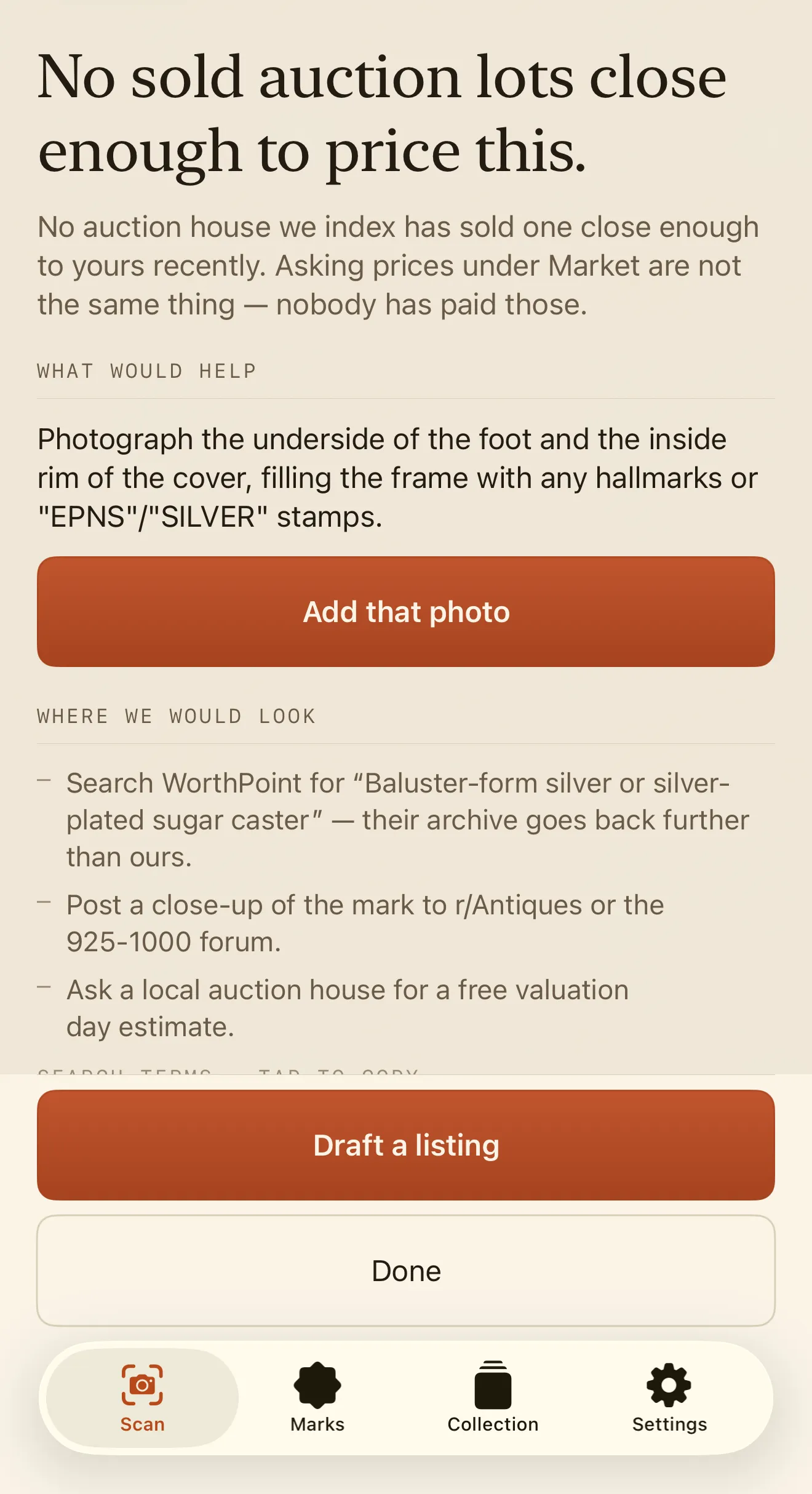
The screen we would point at first

"Nobody's sold one of these lately that I can find. Here's where I'd look."
Cyril, who is a magpie
The same scan, three ways
03
One scan, one answer, three readings of it. Archive is what the object is and what it has sold for. Market is what people are asking for one today. Profit is whether buying it at the price on the label would leave you anything.
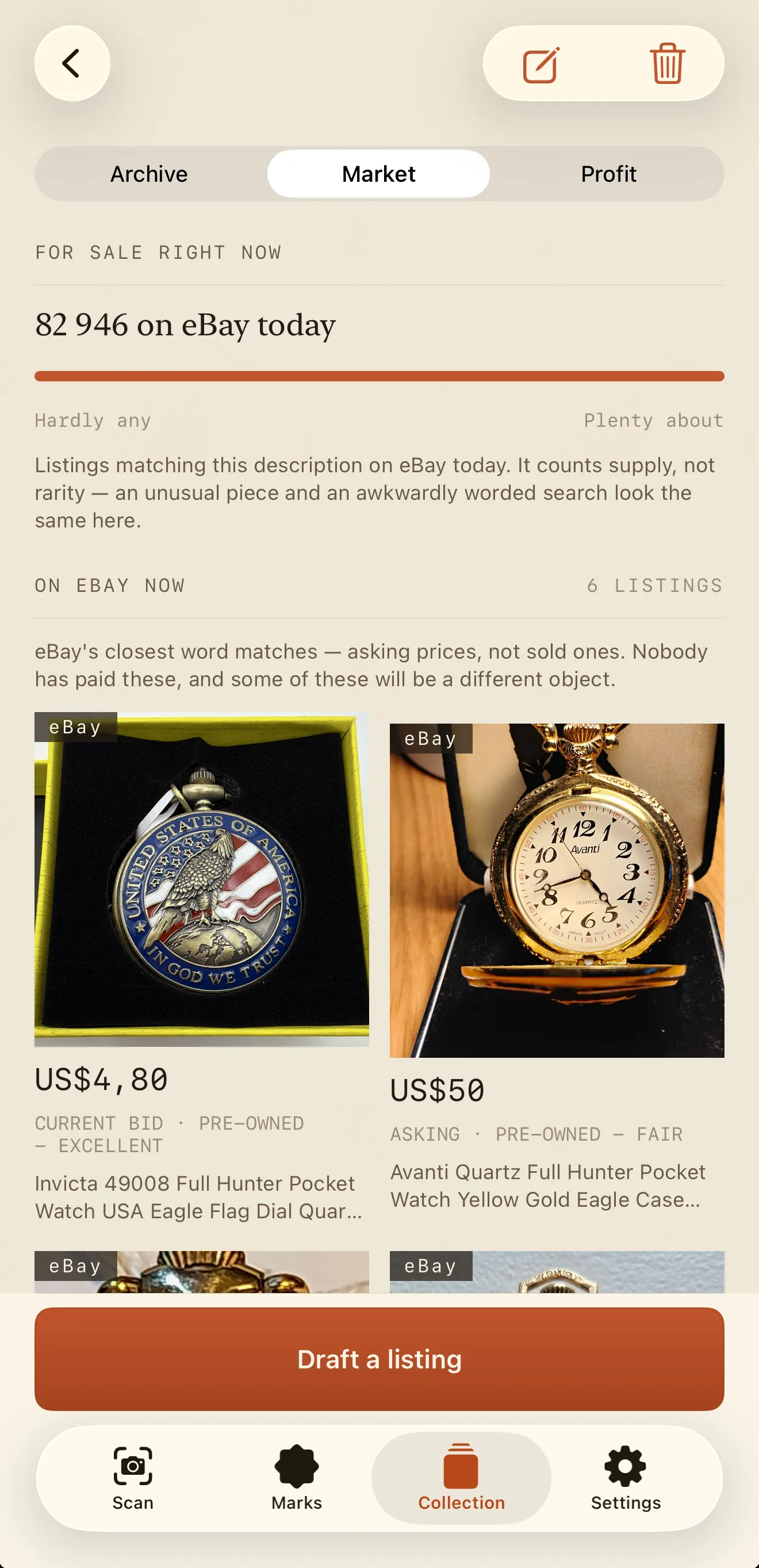
Market — asking, not sold
The rows under Market come from eBay and they are live listings — what somebody wants today, with nothing behind it. They never touch the valuation, and the app says so above them in as many words: nobody has paid these.
The bar above them counts how many are listed, and it is labelled hardly any to plenty about rather than common to extremely rare. The category leader draws the same chart with the rarity words and then admits underneath that it is measuring listing volume — a different claim. A genuinely rare object and a badly worded search produce the same low number.
Profit is for the person standing at a stall with the object in their hand. Type what they are asking and it does the arithmetic out loud — the estimate, the asking price, the selling fees, and what is left.
It will not say BUY on fewer than three sold lots. Below that there is no market to speak of, only an anecdote, and the screen names which one it is looking at. The verdict here is PASS, and the line under the estimate explains why it could never have been better than THINK.
Fees and postage are yours to set, and editable from the row that spends them.
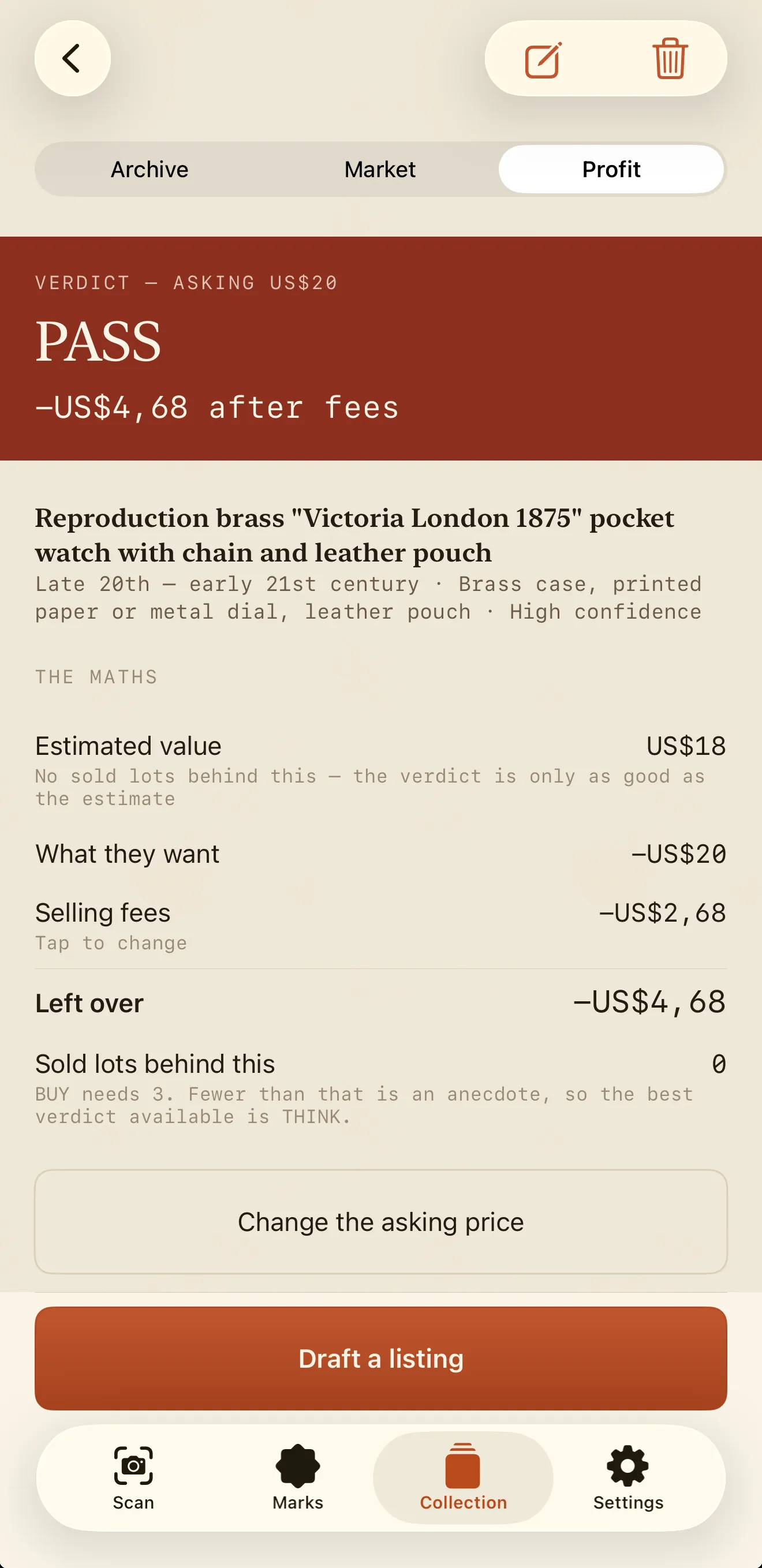
Profit — the arithmetic, out loud
Marks get their own camera
04
A British hallmark is four or five punches the size of a grain of rice, and it is the most informative thing on the piece: the standard, the assay town, the year, and the maker.
Patine has a separate mode that opens straight into a close-up of the mark and reads it — the glyphs it can see, the maker, the assay city, the date-letter year, the standard — and flags a model that is frequently reproduced, with what to check.
It is also why the app asks for a second photograph, and then stops asking. Across our own test set, confidence improved on 30 of 43 objects photographed with a close-up of the mark, against 6 of 14 with extra photographs and no mark. Two frames is what earns its keep; the third and fourth bought nothing measurable and were the ones that timed out.
We write the guides too — how to read a hallmark, what the lion passant actually means, and why a country mark is a floor rather than a date. Every date in them carries the authority it came from.
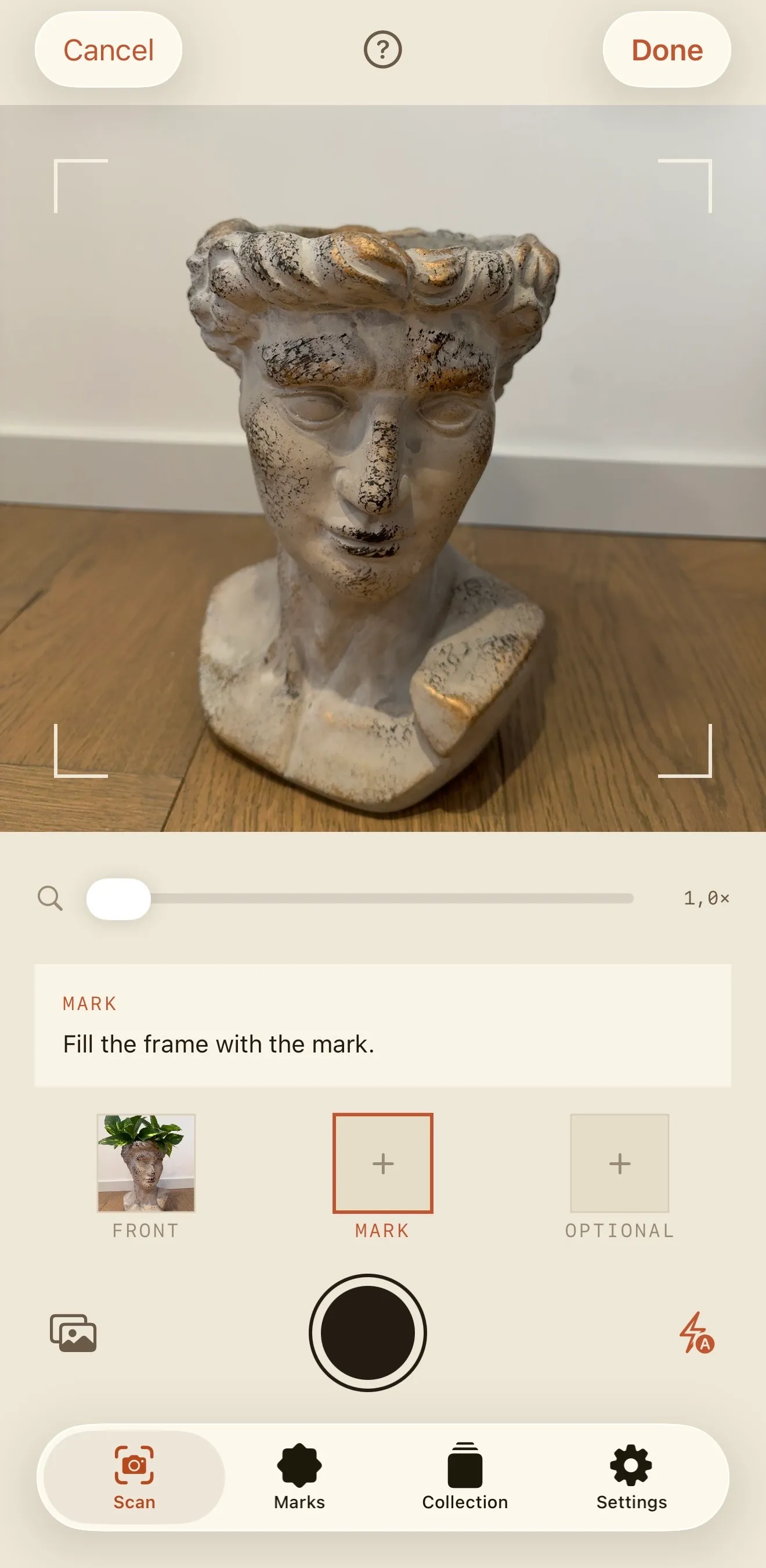
Two frames, and then it stops asking
Pricing, with the numbers printed
05
3 complete free scans — the full result and the full evidence, nothing blurred and nothing truncated. The paywall does not appear until you have seen the third one in full.
| Plan | Price | Scans |
|---|---|---|
| Yearly | $39.99 a year after a 3-day free trial | Unlimited |
| One week | $6.99 a week | 50 |
That 50 is on the paywall too, before you buy. A scan costs us real money, so an uncapped week would either be a loss we quietly absorbed or a promise we quietly broke — and "unlimited" in the listing with "subject to fair usage" in the terms is the pattern this whole app was built against. If we ever stop showing the number, the right fix is to remove the cap, not the sentence.
Both plans renew automatically at the end of each period until you cancel — there is no one-off purchase to offer, because the App Store has no such product. The weekly renews weekly, and its 50 appraisals come back with it. That is the fact most worth printing on a weekly plan, and the table above says the price a week for the same reason.
Prices shown are the United States storefront; your own currency and price appear in the app before you are asked to confirm. Cancel in two taps in the App Store, and the app shows you where. No review gate, ever.